A motorized ball valve with position feedback not only opens and closes the pipeline but also provides an electrical signal to indicate the actual valve position.
This feature is particularly useful in industrial automation, water treatment, HVAC, irrigation, and other automated systems where the controller needs to confirm whether the valve has successfully reached the fully open or fully closed position.
But how does position feedback work? Is it the same as modulating control? And when should you choose a motorized ball valve with feedback?
This guide explains the basics.
What Is a Motorized Ball Valve with Position Feedback?
A motorized ball valve with position feedback is an electrically operated ball valve equipped with a feedback circuit that provides a signal when the valve reaches a specified position.
For a typical on/off motorized ball valve, the two most common feedback states are:
- Fully open position
- Fully closed position
The external controller can use these signals to confirm the actual operating status of the valve.
For example, a PLC may send a command to open the valve. Instead of assuming that the valve has opened successfully, the control system can wait for the open-position feedback signal before continuing to the next step of the process.
This provides an additional level of status confirmation for automated systems.
How Does Position Feedback Work?
Inside a typical motorized ball valve actuator, the motor drives the valve through a gear mechanism.
As the valve rotates toward the open or closed position, an internal position detection mechanism identifies when the required end position has been reached.
The actuator can then provide a corresponding electrical feedback signal to the external controller.
A simplified opening sequence looks like this:
Controller sends OPEN command → Actuator rotates → Valve reaches fully open position → OPEN feedback signal is generated
The closing sequence works in the same way:
Controller sends CLOSE command → Actuator rotates → Valve reaches fully closed position → CLOSED feedback signal is generated
The external controller can therefore compare the command it sent with the actual valve position.
Why Is Position Feedback Important?
In a simple application, sending an open or close command may be sufficient. However, in many automated systems, the controller needs to know whether the command was actually completed.
Without position feedback:
Controller sends OPEN command → Controller assumes the valve is open.
With position feedback:
Controller sends OPEN command → Valve operates → Open-position feedback is received → Controller confirms the valve is open.
This can be particularly useful when valve position is part of a larger control sequence.
Position Feedback Does Not Mean Modulating Control
This is one of the most important distinctions when selecting a motorized ball valve.
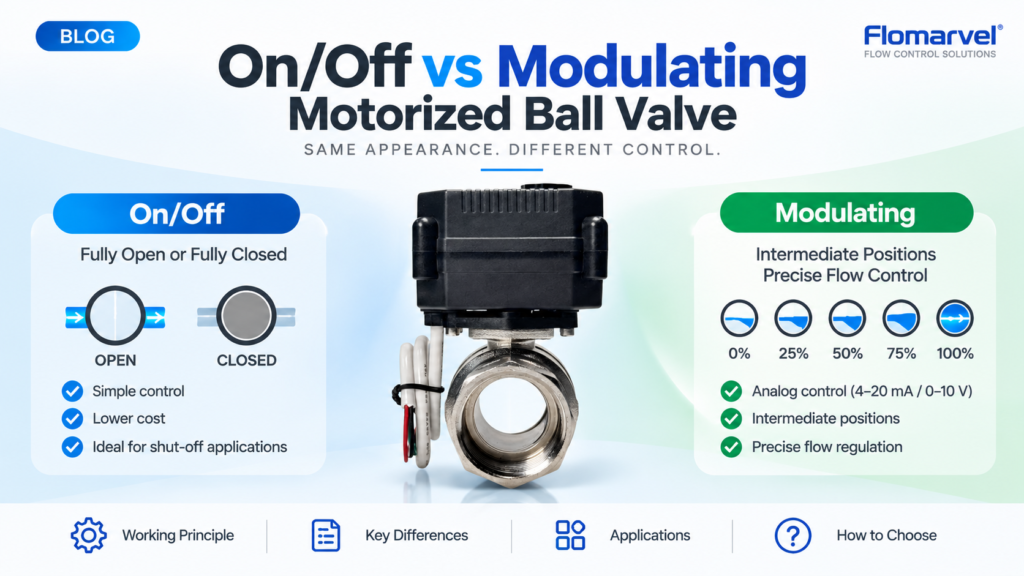
A valve with position feedback is not necessarily a modulating valve.
An on/off motorized ball valve may provide feedback for only two positions:
Fully Open / Fully Closed
The feedback simply tells the controller that the valve has reached one of these positions.
A modulating motorized ball valve, by comparison, is designed to control intermediate valve positions using signals such as:
- 4–20 mA
- 0–10 V
- 2–10 V
For example, a modulating valve may be commanded to move to 20%, 50%, or 80% opening.
Therefore:
Position Feedback = Confirmation of valve position
Modulating Control = Control of valve position
The two functions should not be confused.
Position Feedback vs Position Indicator
Another common misunderstanding is the difference between a position indicator and position feedback.
A position indicator provides a visual indication of the valve position on the actuator itself.
Position feedback provides an electrical signal that can be used by an external controller.
| Function | Position Indicator | Position Feedback |
|---|---|---|
| Shows valve status | Yes | Yes |
| Visual indication | Yes | Not necessarily |
| Electrical signal | No | Yes |
| Can be read by PLC/controller | No | Yes |
| Remote status monitoring | No | Yes |
For automated systems, electrical position feedback is generally more useful because the status can be incorporated into the control logic.
What Can a Controller Do with Position Feedback?
The exact function depends on the control system.
Position feedback can be used for:
- Valve open/closed confirmation
- PLC status monitoring
- Process sequencing
- Interlock control
- Alarm logic
- Remote valve status indication
- Fault detection
For example, suppose a controller sends an OPEN command but does not receive an open-position feedback signal within the expected operating time.
The control system may be programmed to identify this as an abnormal condition and generate an alarm.
The feedback itself does not necessarily diagnose the cause of the problem, but it gives the control system additional information about whether the expected valve position has been reached.
What Is a 5-Wire Motorized Ball Valve with Position Feedback?
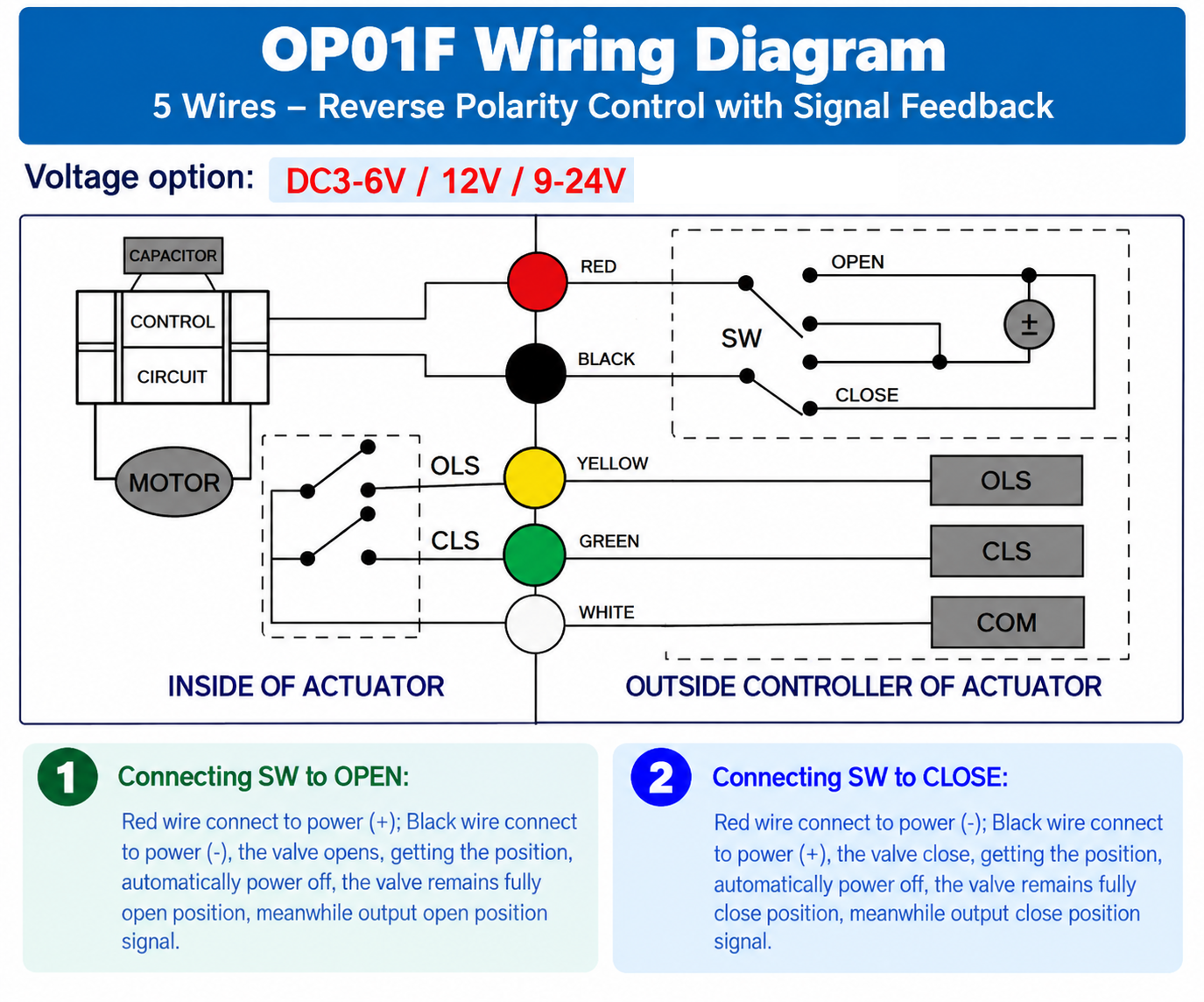
Some motorized ball valves use a 5-core cable to combine valve control and position feedback.
For example, a reverse-polarity motorized ball valve may use:
- 2 wires for motor control
- 2 wires for position feedback
- 1 common (COM) wire
This allows the same actuator cable to provide both valve operation and open/closed position information.
However, the exact wiring arrangement depends on the actuator design. Always refer to the manufacturer’s wiring diagram before connecting the valve to a PLC, relay, or other controller.
Different Control Methods Can Include Position Feedback
Position feedback is not limited to one particular motorized valve wiring method. Depending on the actuator design, feedback can be incorporated into different control configurations.
Reverse Polarity Control
Reversing the polarity changes the direction of motor rotation, allowing the valve to open or close. Position feedback can be added to confirm the fully open and fully closed positions.
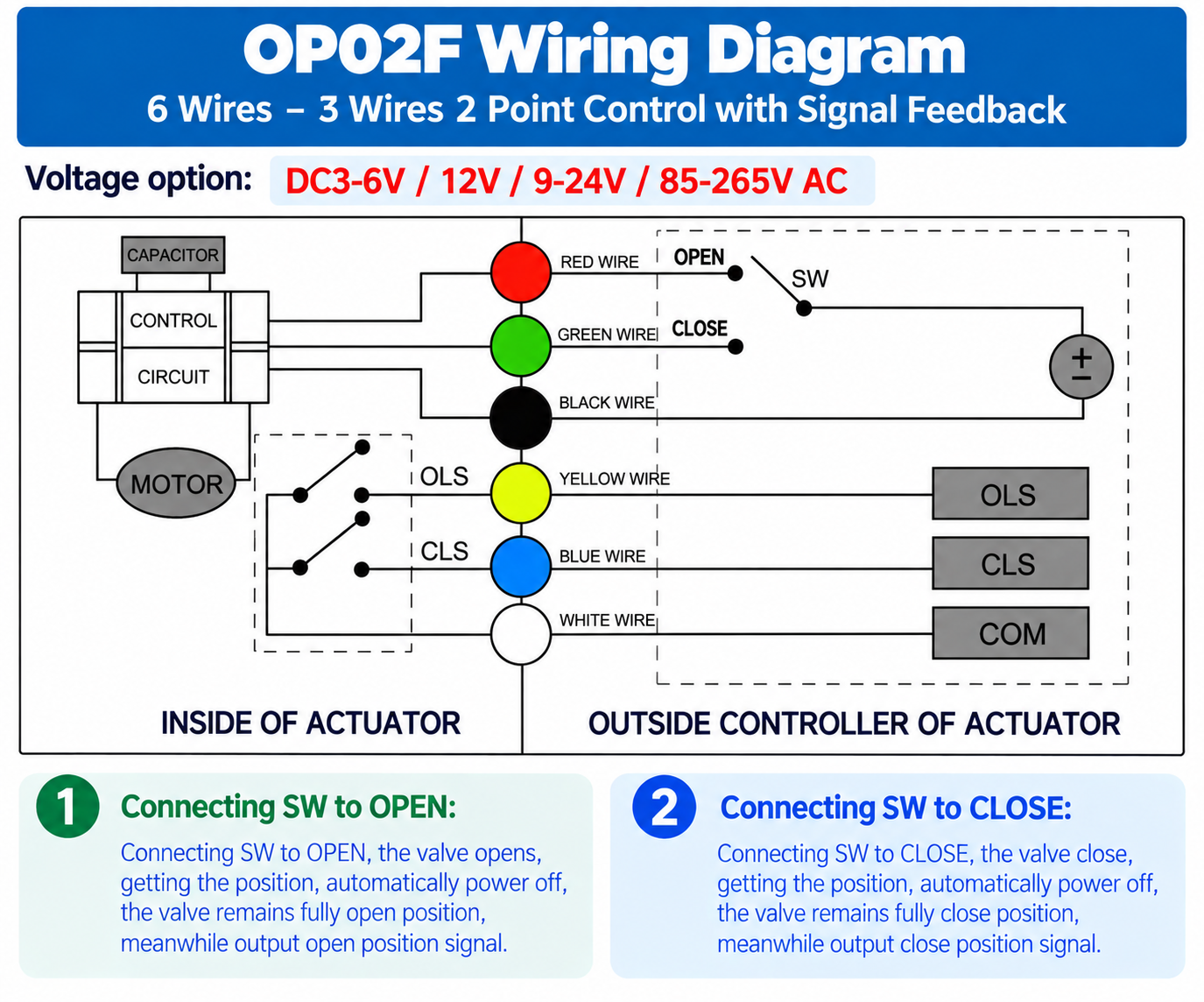
3-Wire Open/Close Control
Separate control wires are used for the opening and closing commands. Position feedback can provide confirmation after each movement is completed.
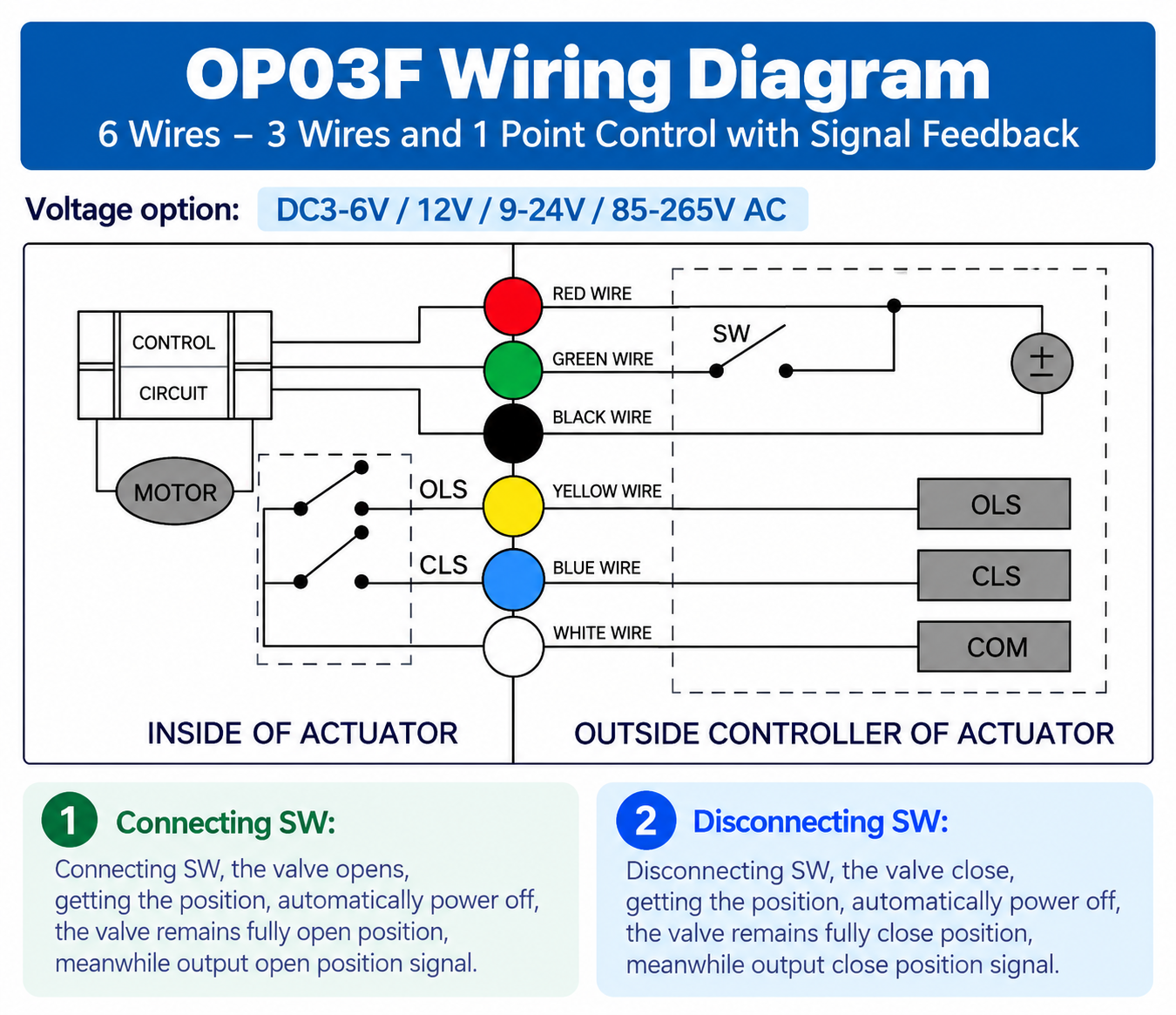
Power On / Power Off Control
The valve changes position according to whether the control power is applied or removed. A feedback circuit can provide additional valve-position information to the controller.
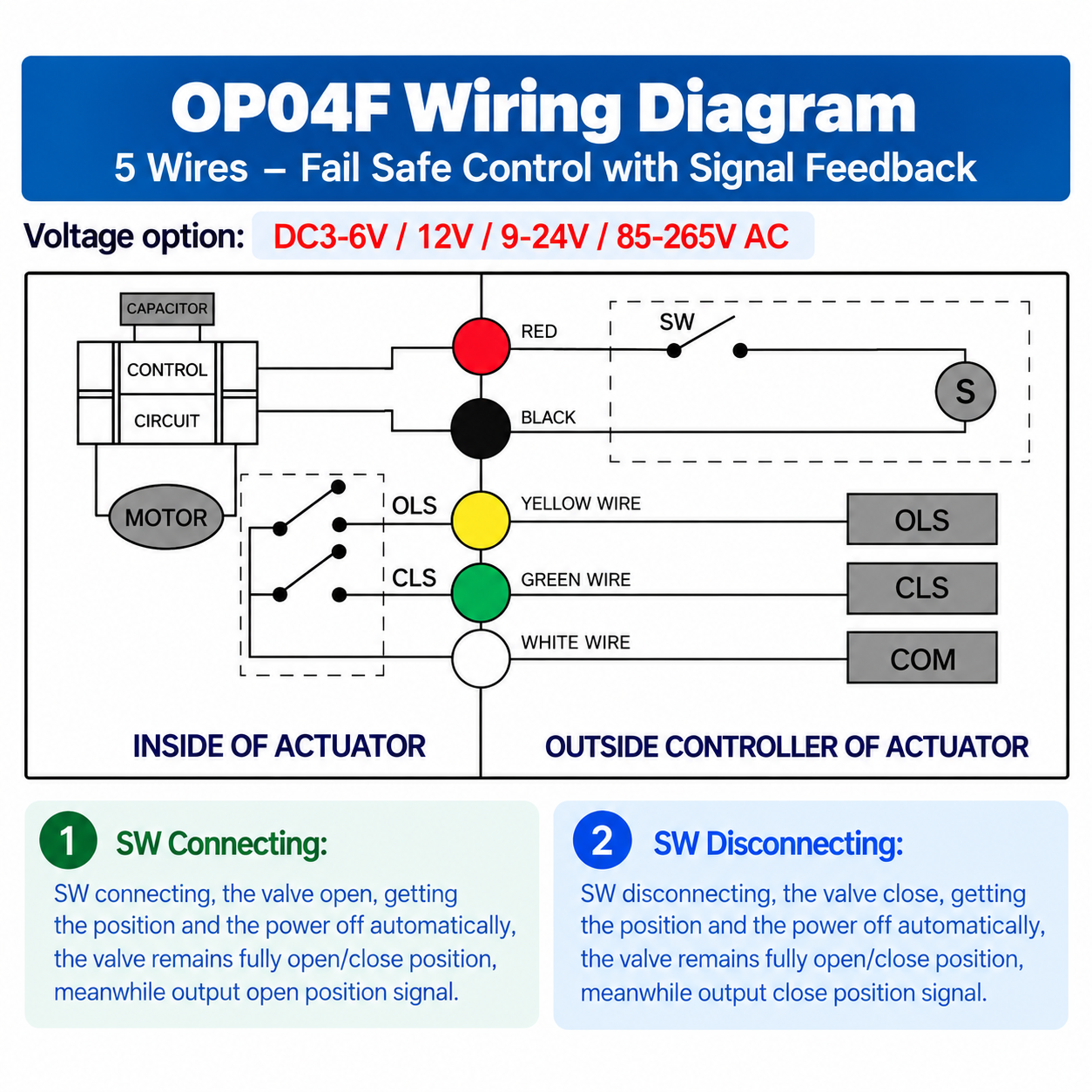
Fail-Safe / Auto-Return Control
The actuator automatically returns to a predetermined position when power is lost. Position feedback can be used to confirm the final valve position.
The exact wiring and feedback logic should always be checked for the specific actuator model.
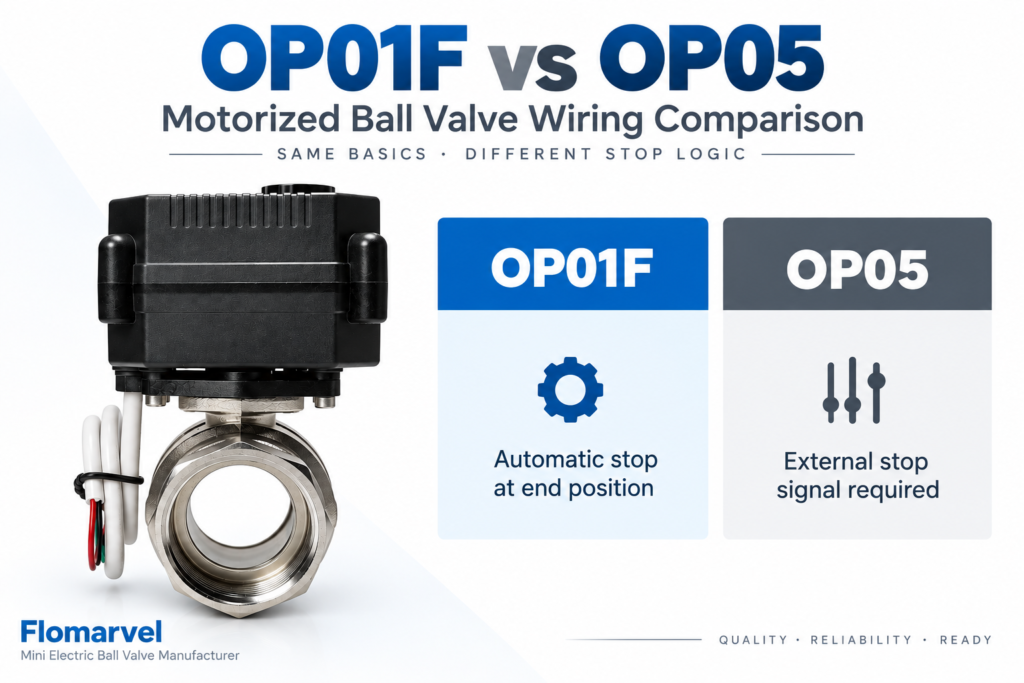
OP01F vs OP05: Why Feedback Logic Matters
Even when two motorized ball valves both provide position feedback, their control logic may not be identical.
For example, Flomarvel OP01F and OP05 both use:
- Reverse-polarity control
- Open/close position feedback
- 5-core cable
- 2 control wires
- 2 feedback wires
- 1 common (COM) wire
However, their end-position stop logic is different.
OP01F automatically stops the motor when the valve reaches the fully open or fully closed position.
OP05, by comparison, requires the external controller to respond to the position feedback and provide the appropriate stop control.
Knowing that a motorized ball valve has position feedback is not enough. You also need to understand how the feedback interacts with the actuator and external controller.
Position Feedback in PLC Control Systems
Position feedback is particularly useful when a motorized ball valve is integrated with a PLC.
A basic PLC sequence might be:
- PLC sends OPEN command.
- Motorized valve begins opening.
- Valve reaches the fully open position.
- Open-position feedback signal is received.
- PLC confirms OPEN status.
- The process continues.
This type of confirmation can be useful in automated equipment where several components must operate in a specific sequence.
For example, a pump could be programmed to start only after the PLC confirms that the required valve has reached the open position.
The actual control logic and safety requirements should be designed according to the specific application.
Where Are Motorized Ball Valves with Position Feedback Used?
Motorized ball valves with feedback can be used in many automated flow-control applications.
Industrial Automation
Equipment controllers can monitor valve status as part of an automated production or process sequence.
Water Treatment
Feedback can confirm whether valves controlling different water lines have reached their commanded positions.
HVAC Systems
Motorized valves can provide open/closed status information to building or equipment control systems.
Irrigation
Central controllers can monitor valve operation in automated water distribution systems.
Tank Filling and Drainage
Position confirmation can be incorporated into pump and level-control sequences.
Leak Detection and Automatic Shut-Off
A control system can command the valve to close after a leak is detected and use position feedback to confirm that the valve has reached the closed position.
How to Choose a Motorized Ball Valve with Position Feedback
Position feedback is only one part of the selection process.
Before choosing a valve, consider the complete operating requirements:
- Valve size
- Connection type
- Body material
- Power supply voltage
- Control method
- Feedback type
- Working pressure
- Operating temperature
- Fluid medium
- Operating time
- 2-way or 3-way configuration
- Fail-safe requirements
- Manual override requirements
- PLC or controller compatibility
For the control system specifically, it is useful to confirm:
- What signal will control the valve?
- What type of position feedback does the controller require?
- Does the actuator stop internally, or must the controller provide the stop control?
Answering these questions before ordering can help avoid wiring and integration problems.
Conclusion
A motorized ball valve with position feedback provides more than simple open/close operation. It gives the external control system information about whether the valve has reached its required position.
This can be valuable for PLC control, process sequencing, remote status monitoring, interlocks, and automated equipment.
However, position feedback should not be confused with modulating control. An on/off valve can provide position feedback while still operating only between fully open and fully closed positions.
When selecting a motorized ball valve, it is important to consider both the control method and feedback logic, as different actuator designs may handle end-position stopping differently.
Need Help Selecting a Motorized Ball Valve with Position Feedback?
Flomarvel provides motorized ball valves with different control methods, voltages, body materials, valve sizes, and position feedback options.
If you are selecting a valve for a PLC or other automated control system, please provide your voltage, valve size, medium, control method, required feedback signal, and controller requirements.
Flomarvel can help you select a suitable motorized ball valve configuration for your application.