On/Off vs Modulating Motorized Ball Valve: What’s the Difference?
When selecting a motorized ball valve, one of the most important decisions is choosing between on/off control and modulating control.
Although both types use an electric actuator to control the position of a ball valve, they are designed for different control requirements.
An on/off motorized ball valve is primarily used to fully open or fully close a pipeline. A modulating motorized ball valve, on the other hand, can position the valve at intermediate openings according to a control signal.
Understanding this difference can help you select the right valve for water treatment, HVAC, industrial automation, irrigation, and other flow control applications.
What Is an On/Off Motorized Ball Valve?
An on/off motorized ball valve is designed primarily for two-position control:
Fully Open → Fully Closed
The actuator receives an electrical command and rotates the valve ball, typically through 90°, between the open and closed positions.
Once the valve reaches its end position, an internal limit switch normally stops the motor.
Depending on the actuator design, common control methods can include:
- Reverse polarity control
- 3-wire open/close control
- Power-on / power-off control
- Fail-safe or auto-return control
- External signal control
Some on/off actuators can also provide position feedback, allowing a PLC or controller to confirm whether the valve has reached the required open or closed position.
Typical Applications
On/off motorized ball valves are commonly used for:
- Water supply shut-off
- Leak detection and automatic water shut-off systems
- Irrigation systems
- Water treatment equipment
- Industrial automation equipment
- Tank filling and draining
- Smart home water control
- HVAC isolation
For applications where the requirement is simply “allow flow” or “stop flow,” an on/off valve is usually the simpler choice.
What Is a Modulating Motorized Ball Valve?
A modulating motorized ball valve, sometimes called a proportional control ball valve, is designed to control intermediate valve positions rather than only fully open or fully closed.
The actuator receives an analog control signal from a PLC, controller, BMS, or other control device and adjusts the valve position accordingly.
Common control signals include:
- 4–20 mA
- 0–10 V
- 2–10 V
For example, in a 0–10 V control system, the controller can command different valve positions by changing the input signal.
Instead of simply switching the flow ON or OFF, the valve can be used to regulate the flow by changing its opening position.
Important: Valve opening percentage and actual flow percentage are not necessarily the same. The actual flow depends on the valve’s flow characteristic, pressure differential, piping system, and other operating conditions.
This distinction is important when selecting a valve for precise flow control.
On/Off vs Modulating Motorized Ball Valve
| Feature | On/Off Motorized Ball Valve | Modulating Motorized Ball Valve |
|---|---|---|
| Main Function | Open / Close | Regulate valve position |
| Typical Positions | Fully open or fully closed | Intermediate positions available |
| Control Signal | Switching / polarity / open-close signals | Analog signal |
| Common Signals | 2-wire / 3-wire control, etc. | 4–20 mA, 0–10 V, 2–10 V |
| Flow Regulation | Not the primary purpose | Yes |
| Control System | Relay, switch, PLC, controller | PLC, PID controller, BMS |
| Control Complexity | Lower | Higher |
| Typical Cost | Lower | Higher |
| Typical Application | Isolation / shut-off | Flow regulation |
The most important difference is therefore:
On/off valves control whether the medium flows, while modulating valves control how much the valve opens.
How Does an On/Off Motorized Ball Valve Work?
The operating principle is relatively straightforward.
When the actuator receives an OPEN command, the motor drives the internal gear system and rotates the valve to the open position.
When it receives a CLOSE command, the actuator rotates the valve in the opposite direction until it reaches the closed position.
Internal limit switches stop the motor when the required end position is reached.
This makes on/off valves suitable for applications where intermediate positioning is not required.
For example, in an automatic water leak detection system:
Leak Detected → Controller Sends Signal → Motorized Valve Closes → Water Supply Is Shut Off
In this application, proportional flow adjustment is generally unnecessary. The primary requirement is reliable shut-off.
How Does a Modulating Motorized Ball Valve Work?
A modulating actuator continuously interprets an analog input signal and moves the valve to the corresponding commanded position.
For example, depending on the actuator’s configured control logic:
| Control Signal | Commanded Valve Position |
|---|---|
| 0 V | 0% |
| 2.5 V | 25% |
| 5 V | 50% |
| 7.5 V | 75% |
| 10 V | 100% |
This allows an automation system to continuously adjust the valve position according to process conditions.
For example:
Sensor → PLC/PID Controller → Analog Signal → Modulating Actuator → Valve Position Adjustment
The sensor may monitor parameters such as:
- Temperature
- Pressure
- Flow
- Liquid level
The controller then adjusts the valve position according to the control strategy.
When Should You Choose an On/Off Motorized Ball Valve?
Choose an on/off motorized ball valve when the system mainly requires the valve to either open or close.
Automatic Water Shut-Off
A leak detector identifies water leakage and sends a signal to close the motorized valve.
There is normally no need to maintain the valve at 30%, 50%, or 70% open.
Irrigation Zone Control
The valve opens when irrigation is required and closes when the watering cycle ends.
Equipment Water Supply
Machines often require automatic control of water entering or leaving the equipment.
Tank Filling
A level sensor or controller can command the valve to open or close according to tank level.
For these applications, an on/off actuator usually provides a simpler and more cost-effective control solution.
When Should You Choose a Modulating Motorized Ball Valve?
Choose a modulating motorized ball valve when the process requires adjustment rather than simple isolation.
HVAC Systems
A modulating valve can adjust water flow according to heating or cooling demand.
Process Flow Control
A PLC or PID controller can change the valve position based on sensor feedback.
Water Treatment Equipment
Some processes require controlled water flow rather than simply starting or stopping it.
Industrial Automation
Modulating valves can be integrated into automated systems that require variable valve positioning.
In these situations, the ability to accept a 4–20 mA or 0–10 V signal can be particularly useful.
Is a Modulating Valve More Accurate?
This requires an important distinction.
A modulating actuator provides more precise valve position control, but this does not automatically mean that the system achieves equally precise flow control.
Actual flow is influenced by factors including:
- Valve size
- Valve flow coefficient (Kv/Cv)
- Pressure differential
- Ball/port geometry
- Pipeline conditions
- Fluid properties
For example, commanding a ball valve to 50% open does not necessarily produce exactly 50% of maximum flow.
Therefore, if accurate flow regulation is required, actuator positioning accuracy should be considered together with the valve’s flow characteristics and the overall control system.
Position Feedback vs Modulating Control
These two functions are sometimes confused.
Position feedback does not necessarily mean that a valve is modulating.
An on/off motorized ball valve may provide feedback signals indicating:
- Valve Fully Open
- Valve Fully Closed
This simply tells the control system the current end position.
A modulating valve, however, accepts a variable command signal that allows the controller to position the valve between fully open and fully closed.
Therefore:
Position Feedback = Reports valve position/status
Modulating Control = Commands intermediate valve positions
A valve can have position feedback while still operating primarily as an on/off valve.
Which One Should You Choose?
Before selecting a motorized ball valve, consider the actual function required by your system.
Choose On/Off Control If:
- You only need OPEN and CLOSED positions
- The valve is primarily used for isolation
- You are building an automatic water shut-off system
- Simple PLC or relay control is sufficient
- Lower system complexity is preferred
Choose Modulating Control If:
- Intermediate valve positions are required
- Flow needs to be adjusted
- Your controller provides 4–20 mA or 0–10 V signals
- The valve is part of a process control loop
- The system uses PLC, PID, or BMS control
The control method should ultimately be selected according to the application rather than simply choosing the actuator with more functions.
Other Specifications to Confirm
Control type is only one part of motorized ball valve selection.
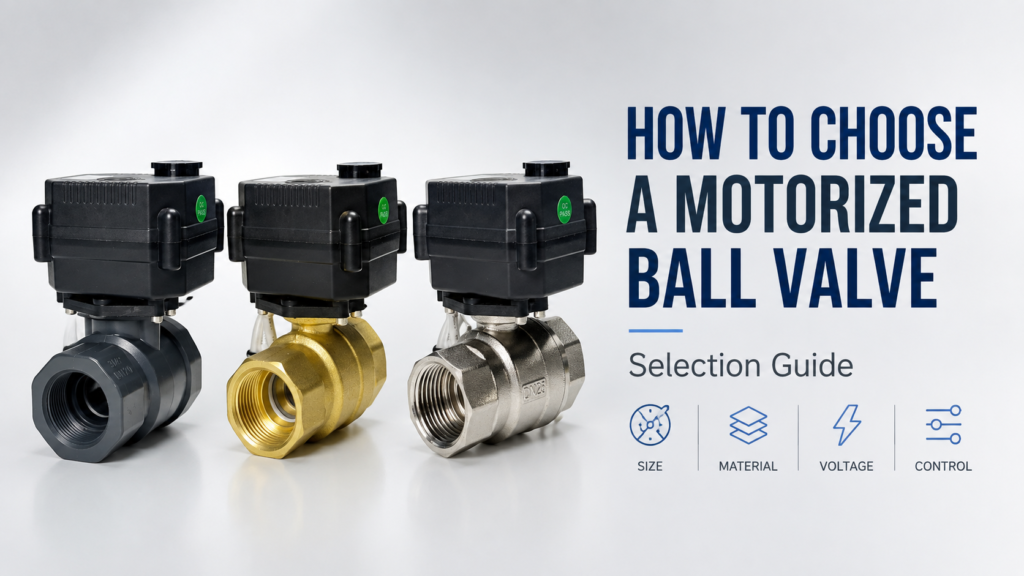
Before ordering, it is also important to confirm:
Valve Size
For example: 1/4″, 3/8″, 1/2″, 3/4″, 1″, 1-1/4″, etc.
Body Material
Brass, stainless steel, UPVC, or other materials depending on the medium and operating environment.
Operating Voltage
Such as DC 5V, 12V, 24V, or AC 110V/220V depending on the actuator.
Connection Type
BSP/BSPP/BSPT, NPT, flange, or other required connections.
Working Pressure and Temperature
Both must remain within the valve’s rated operating range.
Medium
Water, air, chemicals, and other media may require different valve body, seat, and sealing materials.
Additional Functions
Depending on the application, you may also need:
- Position feedback
- Manual override
- Fail-safe / auto-return
- Position indicator
- RS485 / Modbus communication
- WiFi / Zigbee control
Frequently Asked Questions
Can an on/off motorized ball valve stop at 50% open?
A standard on/off actuator is primarily designed for fully open and fully closed operation. If controlled intermediate positioning is required, a modulating actuator is generally more appropriate.
What signals are commonly used for modulating motorized ball valves?
Common analog control signals include 4–20 mA, 0–10 V, and 2–10 V.
Is a 4–20 mA motorized ball valve a modulating valve?
In most applications, a motorized ball valve using a 4–20 mA positioning command is considered a modulating or proportional-control valve.
Does 50% valve opening mean 50% flow?
Not necessarily. Flow depends on valve characteristics, pressure differential, piping conditions, and other factors.
Can an on/off valve have position feedback?
Yes. An on/off actuator can provide open/closed position feedback without being a modulating actuator.
Conclusion
The difference between an on/off and modulating motorized ball valve comes down primarily to the required control function.
An on/off motorized ball valve is suitable when the application requires reliable opening and closing for isolation or automatic shut-off.
A modulating motorized ball valve is more appropriate when the system needs intermediate valve positioning and variable flow regulation through signals such as 4–20 mA or 0–10 V.
Selecting the correct control type can simplify system integration and avoid paying for functions that the application does not require.
Need Help Selecting a Motorized Ball Valve?
If you are unsure whether your application requires on/off or modulating control, provide us with your valve size, medium, voltage, working pressure, temperature, control signal, and application requirements.
Flomarvel can help you identify a suitable motorized ball valve configuration for your application.