How to Choose the Right Motorized Ball Valve: A Complete Selection Guide
Choosing the right motorized ball valve involves more than simply matching the valve size to the pipe. Valve body material, operating voltage, control method, working pressure, temperature, medium compatibility, and additional control functions can all affect valve performance and service life.
Whether the valve is used in industrial automation, water treatment, HVAC, irrigation, or equipment integration, understanding these factors before ordering can help avoid compatibility issues and unnecessary costs.
This guide explains the key factors to consider when selecting a motorized ball valve for your application.
1. Determine the Valve Size and Connection Type
The first step is to confirm the required valve size and pipe connection.
The valve should match the piping system while providing sufficient flow capacity for the application. Common sizes for compact motorized ball valves include:
▪ 1/4″
▪ 3/8″
▪ 1/2″
▪ 3/4″
▪ 1″
▪ 1-1/4″
In addition to nominal size, consider the internal flow diameter. A full-port ball valve provides a larger flow passage and generally results in lower pressure drop than a reduced-port design.
The connection standard should also be confirmed before ordering. Common threaded connections include BSP, BSPP, BSPT, and NPT, depending on the market and piping system.
Tip: Do not select a valve based on nominal size alone. Always check the connection standard and actual flow requirements.
2. Choose the Right Valve Body Material
Motorized ball valves are available in different body materials. The correct choice depends primarily on the medium, operating temperature, pressure, environment, and corrosion requirements.
● Stainless Steel
Stainless steel motorized ball valves provide good corrosion resistance and mechanical strength. They are commonly used in industrial equipment, water treatment systems, automation systems, and other demanding applications.
Common options include SS304 and SS316/316L.
● Brass
Brass motorized ball valves offer a good balance between performance and cost. They are widely used in water systems, HVAC, irrigation, smart home applications, and general automation equipment.
● PVC
PVC motorized ball valves are lightweight and corrosion resistant. They are commonly used in water treatment, irrigation, and compatible chemical-fluid applications.
However, material selection should never be based on the valve body alone. Always confirm the compatibility of the valve body, ball, valve seat, O-rings, temperature, pressure, and actual medium before selecting a valve.
3. Confirm the Operating Voltage
The actuator voltage must match the available power supply and control system.
Common motorized ball valve voltage options include:
▪ DC 5V
▪ DC 12V
▪ DC 24V
▪ AC 110V
▪ AC 220V
For many low-voltage automation systems, 12VDC and 24VDC motorized ball valves are commonly used.
Before ordering, check whether your system provides AC or DC power and confirm the required voltage range.
Using the wrong voltage may prevent the actuator from operating correctly and can potentially damage electrical components.
4. Select the Right Wiring and Control Method
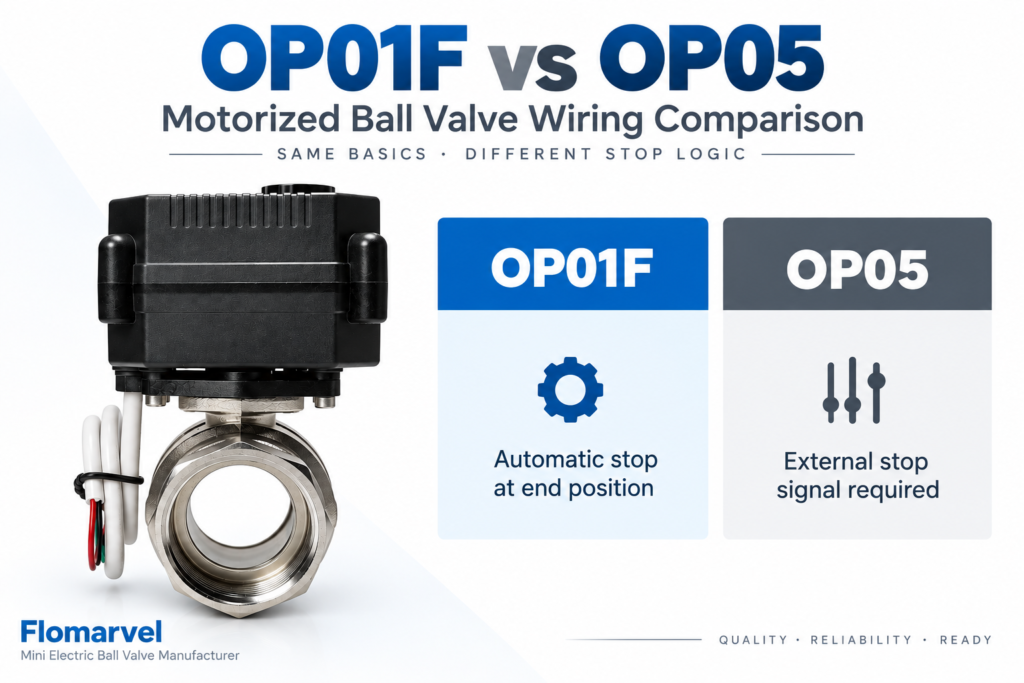
Two motorized ball valves may look identical but operate very differently because of their wiring and control logic.
Common control methods include:
● Reverse Polarity Control
The valve changes between open and closed positions by reversing the polarity of the power supply.
This configuration is commonly used where a controller can reverse the DC polarity.
● 3-Wire Open/Close Control
Separate control wires are used for opening and closing the valve.
OPEN signal → Valve opens
CLOSE signal → Valve closes
This makes it convenient for integration with relays and automation controllers.
● 3-Wire Power On/Off Control
This control method uses a different logic:
Power ON → Open
Power OFF → Close
Although both this configuration and the previous one may use three wires, their operating logic is different.
● Fail-Safe / Auto-Return Control
A fail-safe motorized ball valve automatically returns to a predetermined position when power is removed.
This is useful in systems where the valve needs to return to a safe state during a power failure.
● External Signal Control
Some applications require the actuator to work with an external PLC, controller, relay, or other control system.
In this configuration, the external control system participates in the operating and stopping logic of the actuator.
Because wiring methods vary significantly, always confirm the control logic before connecting the valve.
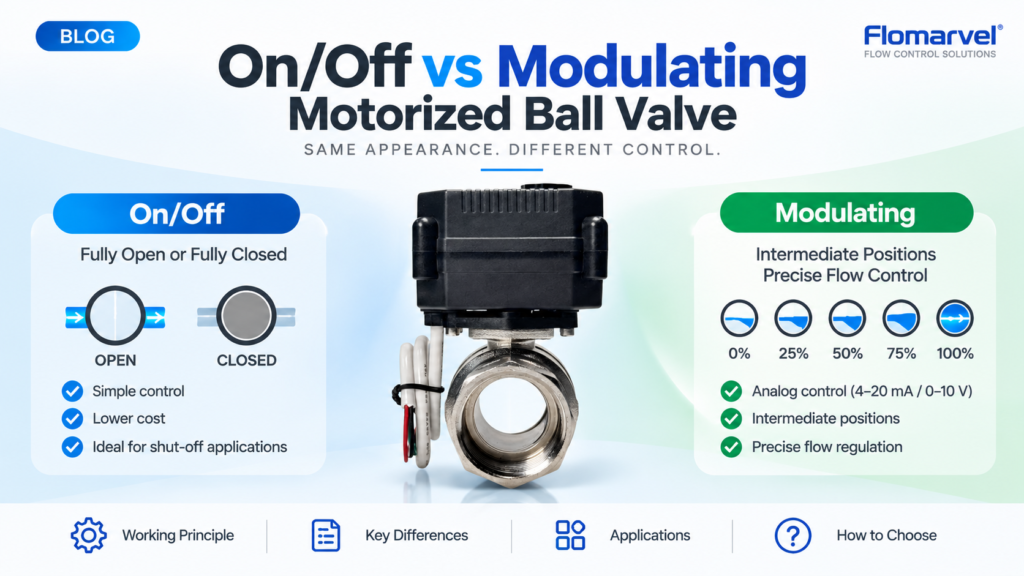
5. Decide Between On/Off and Modulating Control
Another important question is whether the valve only needs to fully open and fully close, or whether you need to control the valve opening position.
● On/Off Motorized Ball Valve
Choose an on/off valve if the application only requires:
Fully Open ↔ Fully Closed
This is suitable for applications such as automatic water shut-off, equipment water supply, irrigation zone control, and many general automation systems.
● Modulating Motorized Ball Valve
Choose a modulating valve when the system needs to regulate the valve position rather than simply open or close it.
Typical control signals may include:
▪ 4–20 mA
▪ 0–10 V
▪ 2–10 V
Modulating valves can be used where more precise flow control or intermediate valve positioning is required.
Important: A standard on/off motorized ball valve should not be confused with a proportional or modulating valve.
6. Check the Working Pressure and Temperature
Always compare the valve specifications with the actual operating conditions of the system.
Three temperature and pressure conditions should be considered separately:
● Working Pressure
The pressure of the fluid inside the valve during normal operation.
● Medium Temperature
The temperature of the liquid or gas passing through the valve.
● Ambient Temperature
The environmental temperature surrounding the actuator and valve.
The valve body may tolerate one temperature range while the actuator, seals, or electronic components have different limitations.
For this reason, the complete valve assembly—not only the metal valve body—should be evaluated.
7. Confirm the Medium
Before selecting a motorized ball valve, ask:
What fluid will pass through the valve?
Typical applications may involve:
▪ Water
▪ Air
▪ Compatible chemical fluids
▪ Other liquids or gases
The same valve material is not automatically suitable for every medium.
For example, chemical compatibility can depend on several factors:
Valve (body + ball) material + valve seat + O-ring material + fluid concentration + temperature + pressure
For chemical or special-fluid applications, provide the supplier with the exact medium, concentration, temperature, and operating conditions before confirming the valve.
8. Choose Between a 2-Way and 3-Way Motorized Ball Valve
The required flow path determines whether you need a 2-way or 3-way motorized ball valve.
● 2-Way Motorized Ball Valve
A 2-way valve has one inlet and one outlet and is mainly used for basic:
Open / Close flow control
It is the most common configuration for automatic shut-off applications.
● 3-Way Motorized Ball Valve
A 3-way valve has three ports and can be used for:
Flow diversion
Flow switching
Mixing applications
Changing the flow path between different pipelines
Three-way ball valves may also use different internal ball configurations, such as L-Port or T-Port.The correct configuration depends on the required flow direction.
9. Consider Additional Functions
Once the basic valve configuration has been selected, consider whether your system requires additional functions.
● Position Feedback
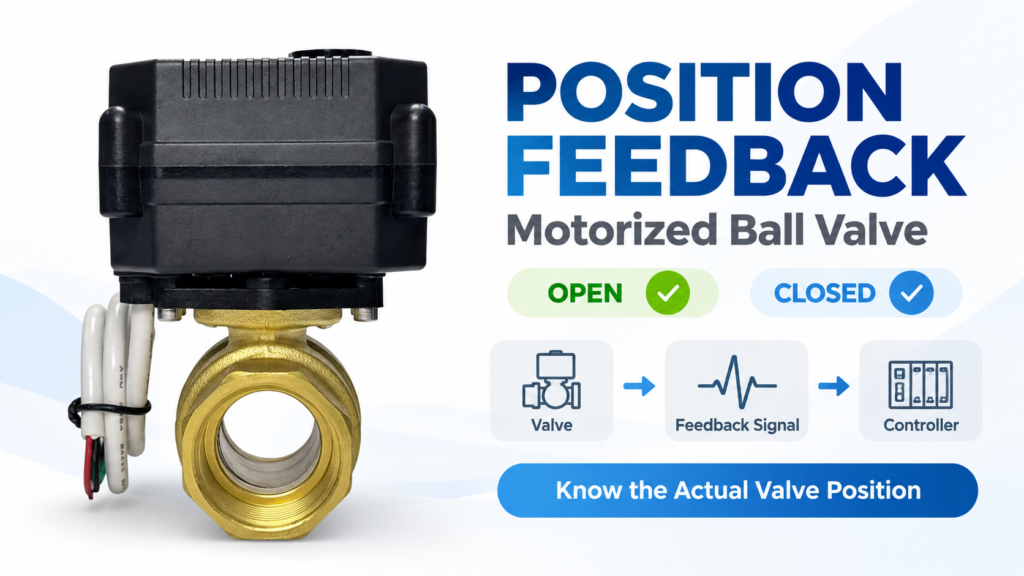
Position feedback allows an external controller to determine the valve’s open or closed status.This can be useful for PLC systems and equipment monitoring.
● Manual Override
A manual override allows the valve to be operated manually when necessary, such as during installation, maintenance, or certain power-loss situations.
● Fail-Safe / Auto Return
The valve automatically returns to a predefined position after power loss.
● Position Indicator
A visual indicator makes it easier to identify the current valve position.
● RS485 / Modbus
For industrial automation applications, RS485/Modbus communication can enable digital control, status monitoring, and system integration.
● WiFi / Zigbee/LoRaWAN/LoRa
For smart home and remote water-control applications, WiFi or Zigbee options can provide remote operation and integration with compatible smart control systems.Not every application requires these functions. Selecting only the functions you actually need can help control both system complexity and cost.
10. Consider the Application Environment
The installation environment can also affect valve selection.
Before ordering, consider:
▪ Indoor or outdoor installation
▪ Humidity and moisture
▪ Exposure to water
▪ Dust
▪ Vibration
▪ Ambient temperature
▪ Available installation space
▪ Frequency of operation
For example, a valve installed in a humid water-treatment environment may require greater moisture protection than one installed inside a dry control cabinet.
Similarly, equipment subject to continuous vibration may require additional attention to electrical connections and mechanical fastening.
11. Check the Operating Time and Duty Requirements
Opening and closing time can be important in automated systems. A faster actuator may be required when the system needs a quick response, while other applications may prioritize low power consumption, torque, or service life instead.
Also consider how frequently the valve will operate.
A valve that operates several times per month has very different duty requirements from one that operates hundreds of times per day.When discussing a high-frequency application with a supplier, provide the expected:
Operating cycles per day or per hour
This helps determine whether the actuator is suitable for the required duty.
12. Motorized Ball Valve Selection Checklist
Before requesting a quotation, prepare the following information:
Selection Item Information to Confirm
Valve Size 1/4″, 1/2″, 3/4″, 1″, etc.
Body Material Stainless Steel / Brass / UPVC
Voltage 5VDC / 12VDC / 24VDC / AC Voltage
Control Type On/Off / Modulating / Fail-Safe / Other
Wiring Method 2-Wire / 3-Wire / Other
Medium Water / Air / Chemical / Other
Working Pressure Maximum system pressure
Medium Temperature Actual fluid temperature
Connection BSP / NPT / Other
Valve Type 2-Way / 3-Way
Special Functions Feedback / Manual Override / RS485 / WiFi, etc.
Quantity Required order quantity
Providing this information at the beginning can significantly improve the accuracy of valve selection and quotation.
Quick Motorized Ball Valve Selection Guide
If You Need… Consider…
Simple open/close control On/Off Motorized Ball Valve
Adjustable valve position Modulating Motorized Ball Valve
Automatic return after power loss Fail-Safe / Auto-Return Valve
Flow diversion or switching 3-Way Motorized Ball Valve
PLC communication RS485 / Modbus or compatible control
Remote smart control WiFi / Zigbee Motorized Valve
Good corrosion resistance Stainless Steel or compatible plastic material
General water/HVAC application Brass Motorized Ball Valve
Water treatment application Stainless Steel or UPVC, depending on the medium
How Do I Choose the Right Motorized Ball Valve?
In simple terms, start with these seven questions:
1. What is the valve size?
2. What medium will flow through the valve?
3. What valve body and seal materials are compatible with the medium? (Ask a professional supplier if you don’t know)
4. What voltage is available?
5. Do you need on/off or modulating control?
6. What wiring/control logic does your system require?
7. What are the operating pressure, temperature, and environmental conditions?
Once these requirements are clear, selecting the correct motorized ball valve becomes much easier.
Conclusion
Choosing the right motorized ball valve starts with understanding the actual application rather than selecting a valve based only on size or price.
Valve size, body material, voltage, wiring method, control type, medium compatibility, pressure, temperature, and installation environment should all be considered before making a final selection.
A correctly selected motorized ball valve can provide more reliable operation, easier system integration, and longer service life.
Need Help Selecting a Motorized Ball Valve?
If you are unsure which configuration is suitable for your application, provide us with your valve size, medium, voltage, working pressure, temperature, control requirements, and quantity. Flomarvel can help you identify a suitable motorized ball valve configuration for your application.